

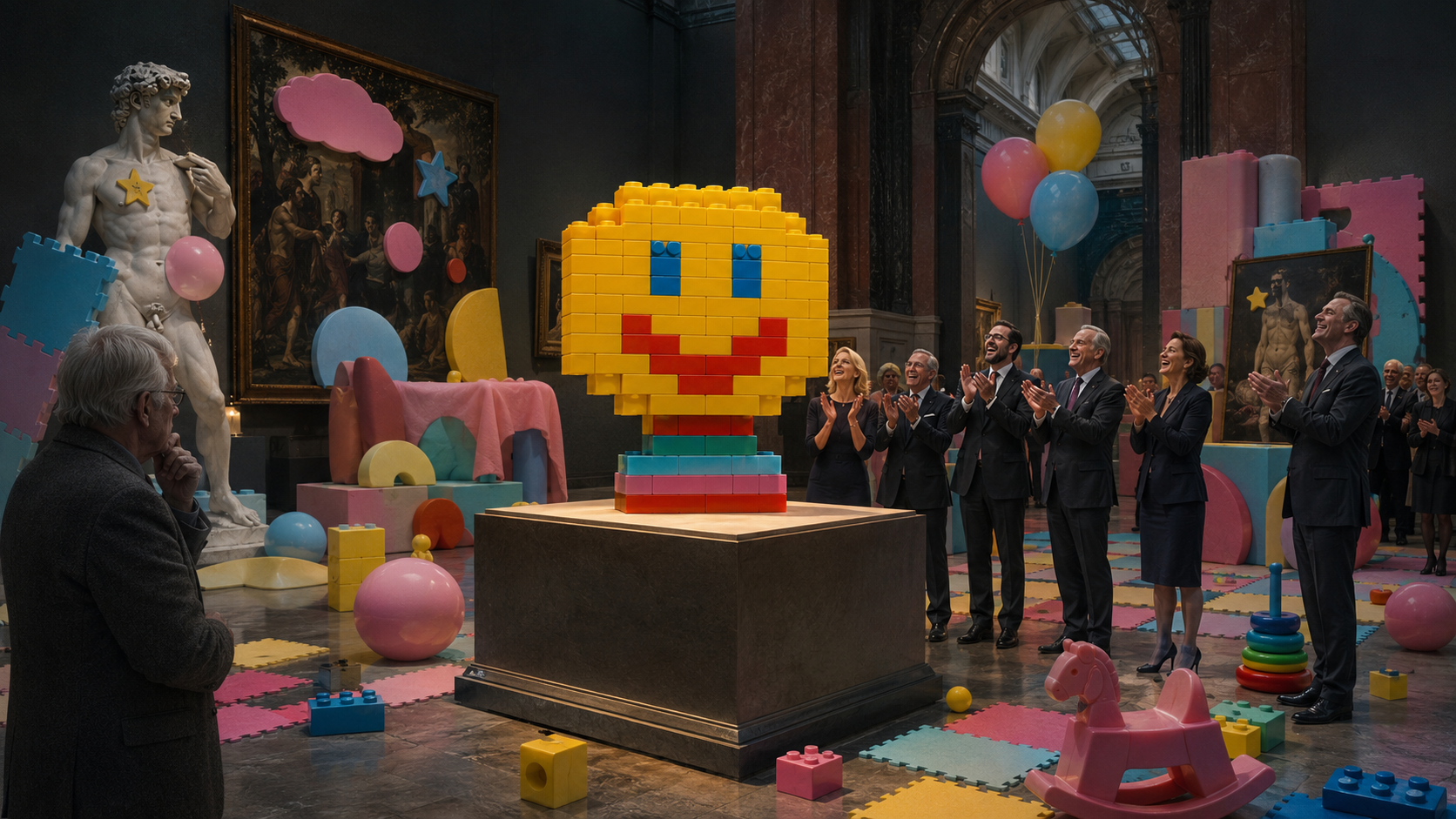
Something peculiar has happened to contemporary culture.
Museums increasingly resemble classrooms, films arrive with their moral conclusions already underlined, and public art is expected to be cheerful, inclusive, educational and impossible to misunderstand. Even rebellion is carefully supervised. It comes with explanatory panels, approved vocabulary and a program of related workshops.
This is the infantilization of culture: not the presence of playfulness, fantasy or popular entertainment, but the assumption that adults must be guided, protected and instructed like children.
Art once invited uncertainty. A painting, novel or performance did not have to provide a clear lesson. It could disturb, seduce, confuse or even offend. The audience was expected to wrestle with contradictions and reach its own conclusions. Today, cultural institutions often seem terrified of leaving visitors alone with an unresolved thought.
Everything must be explained. Wall texts tell us what to notice, promotional materials tell us what to feel, and curators tell us why a work is socially relevant. Art is no longer allowed merely to exist; it must demonstrate that it is useful, responsible and morally sound.
Culture Without Danger
This development has several causes. One is institutional risk aversion. Museums, broadcasters, theatres and funding bodies depend on politicians, sponsors, visitor numbers and public approval. Ambiguous art is difficult to defend in a spreadsheet. A colourful family exhibition, an uplifting community project or a production attached to a fashionable social theme is easier to explain to managers.
The result is culture designed by committee. It may look adventurous, but its risks have usually been calculated in advance. Controversy is welcome only when it confirms the institution’s existing values. Genuine unpredictability—the possibility that a work might escape its intended message—is treated as a communications problem.
Another cause is the dominance of marketing. Audiences are increasingly approached as consumers whose attention must be captured immediately. Complexity becomes “inaccessible.” Silence becomes “boring.” Difficulty becomes “elitist.” Art must be friendly, photogenic and easy to share.
Digital platforms intensify this tendency. Algorithms reward instant emotional responses: admiration, outrage, sentimentality and recognition. Subtlety performs badly because it takes time. A work that cannot be understood in a few seconds risks disappearing from view.
Yet accessibility and infantilization are not the same thing. Art should not be deliberately obscure merely to flatter a cultural elite. Museums should welcome newcomers, and public institutions should remove unnecessary barriers. But welcoming people is different from underestimating them. An accessible entrance does not require an intellectually simplified interior.
The Moral Lesson
The most troubling form of infantilization is the transformation of art into moral instruction.
Increasingly, artworks are judged less by what they make possible than by whether they communicate the correct position. Characters in films and novels must serve as examples. Historical works are surrounded by warnings and explanations. Artists are expected to function as social workers, political representatives and ethical educators.
Important political art certainly exists. Art can expose injustice, challenge authority and give form to experiences that have been ignored. But political art loses its force when its conclusions are predetermined. When the viewer is told exactly what to think, art becomes propaganda—even when its message is admirable.
Mature culture recognises that human beings are inconsistent. Victims can be cruel, villains can be charming, progress can create destruction, and beauty can emerge from morally compromised circumstances. Art gives us a place to encounter these contradictions without immediately resolving them.
An infantilized culture cannot tolerate such uncertainty. It divides the world into heroes and villains, safe and unsafe, approved and forbidden. It replaces interpretation with obedience.
How Do We Stop It?
First, cultural institutions must recover their confidence in the intelligence of the audience. Visitors do not need to understand everything immediately. Confusion is not institutional failure. Sometimes it is the beginning of attention.
Explanatory texts should provide context without dictating conclusions. Educational programmes should open questions rather than close them. Curators should occasionally resist the temptation to justify every exhibition through a fashionable social purpose.
Second, artists need greater freedom from managerial language. Funding applications often force them to predict the meaning, audience, social effect and measurable outcome of work that does not yet exist. This encourages artists to become skilled bureaucrats and discourages genuine experimentation.
Funding bodies should support uncertainty. A serious artistic process may fail, change direction or produce something that cannot be summarised in advance. That is not a defect; it is part of creation.
Third, criticism must return. Much contemporary cultural writing resembles promotion. Critics hesitate to make judgments, while institutions describe nearly every project as urgent, groundbreaking or transformative. Without independent criticism, standards become meaningless.
Good criticism does not tell audiences what they are permitted to enjoy. It offers arguments, makes distinctions and takes art seriously enough to disagree with it.
Fourth, arts education should teach looking, listening, reading and interpretation—not merely self-expression. Young people deserve more than the reassurance that every creative gesture is equally valuable. They should encounter works that resist them, learn how form creates meaning and discover that artistic freedom includes discipline, knowledge and revision.
Finally, we must defend cultural pluralism. There should be room for difficult art, popular art, traditional craftsmanship, radical experimentation, beauty, ugliness, entertainment and failure. No single political programme, market formula or curatorial fashion should determine what culture is allowed to become.
The opposite of infantilization is not solemnity. Art does not need to become more respectable, academic or joyless. Humour, absurdity, games and fantasy can be profoundly adult. The essential difference is freedom: the freedom of artists to create without providing a moral instruction manual, and the freedom of audiences to interpret without supervision.
We will not revive culture by demanding that art grow up. We will do it by allowing the public to be adults.
Add comment
Comments